In a letter to the Chair of Homes England, Matthew Pennycook, Minister of State (Housing, Communities & Local Government) has outlined the government’s “immediate priorities”.
One of them is for Homes England to maximise the number of social rent homes “delivered through the allocation of remaining Affordable Homes Programme funding”. However, the letter gives no indication as to what proportion of the remaining funding should go to social rent homes as opposed to “affordable rent”, “shared ownership” and “affordable ownership”.
The “remaining funding” is the parsimonious funding bequeathed by the Tories. This reinforces what Matthew has said previously that the government is not increasing the funding available in the Tories AHP, which runs until 2026.
What has this funding produced in the first three year of the AHP? Statistics from Homes England (for England, excluding London) show what the grant has been used for.
- Social rent 14.83%;
- “Affordable rent” 44.57%, and
- Affordable Home Ownership 37.71%.
If you look at the funding allocations agreed so far, rather than those built, (see Appendices) there is a slight increase in social rent homes, but only to 15.48%. When you take account of market homes which are built as part of developments funded by Home England (so-called cross-subsidy), comprising 27.5% of all homes, then social rent homes comprise just 10.75% of those built.
Increasing the grant for social rent homes necessarily means reducing it for “affordable rent” and the various forms of ownership. The most effective way to maximise their number would be to devote all the funding for social rent. However, if the ‘size of the pot’, the overall funding bequeathed by the Tories, remains the same, it won’t stretch very far, because the grant for social rent is higher: £72,832 per property than £48,962 for “affordable rent” and £43,742 for “affordable home ownership”. And there is no guidance in the letter on the level of grant per unit which will be available now.
What grant will be available in Labour’s expected AHP for 2027 and after remains to be seen. News is not expected until the Spring Review next year. But we need the government to increase the funding of the AHP now to drive up the building/acquisition of social rent homes or the increase will be marginal.
“Affordable rent”
“Affordable rent” was introduced as part of the Tories austerity programme. It was a means of cutting grant and making tenants pay higher rents to contribute to the cost of funding new build. The higher rents mean that the exchequer has to fund more housing benefit than it would if they were social rent homes. The average “affordable rent” home pays rent which is 47.8% higher than social rent, for England, and 66% higher in London.
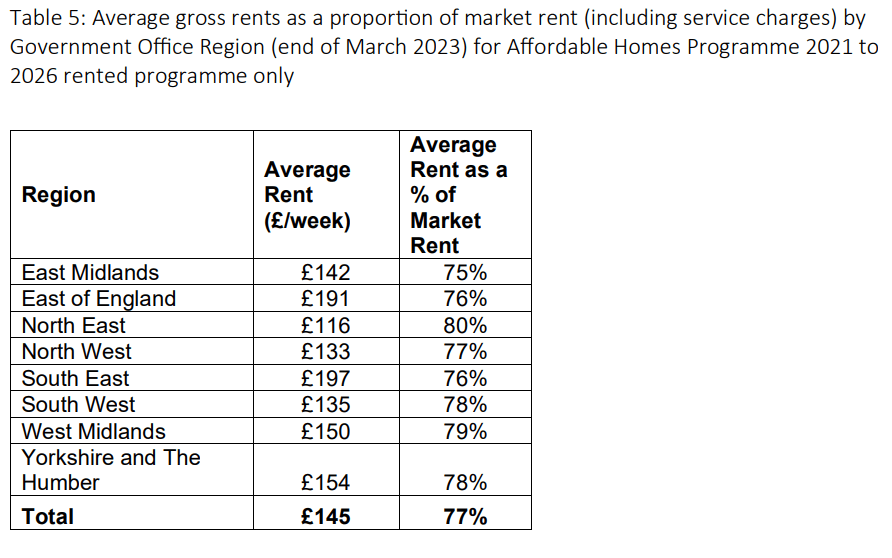
Homes England’s Summary Report to the end of March 2023 poses a question in relation to the rent levels resulting from their funding. In all the English Regions (excluding London) rents, including service charges are not far short of 80% or market rents, averaging 77%.
So government funding is producing rents which are increasingly unaffordable for tenants and drive up the housing benefit bill. This makes no sense.
“Diversification of the housing market”
Matthew Pennycook wants Homes England to “support the diversification of the housing market”. “As such, I want to see it continue to support efforts to grow the SME and Build to rent sectors (including developing new finance opportunities and increasing SME access to Homes England sites and services)…” Build to rent enables companies that are not registered providers of social housing to gain grant for building programmes. So-called “affordable private rent” is set at 20% discount, equivalent to “affordable rent” for councils and housing associations, but it’s increase is determined by market rents in the development it is built in. Given the proliferation of private rent which has resulted from the acute shortage of social housing, especially council housing, why would the government want to promote rent at 80% of the market rate? Where the tenant qualifies for Local Housing Allowance the higher rent increases the cost to central government.
In addition Matthew Pennycook expects Homes England to
“attract institutional investment into UK residential real estate (including supporting the Department’s work on achieving greater leverage, attracting new investment partners and using the higher delegations we hope to secure from HM Treasury to engage in more equity investments and Joint Ventures with the Agency taking a more direct role in delivery of such schemes).”
This is looking at the wrong ‘solution’. We know from the experience of the Private Finance Initiative in housing (and elsewhere) that this ‘partnership’ was a means of fleecing councils and tenants in the quest for maximising profit. As Stuart Hodkinson showed in his book “Safe as Houses” this often involved very shoddy work.
“Shared ownership”
“Shared ownership”/part-rent/part-buy is not really ownership at all. You pay rent and mortgage at the same time and are responsible for repairs. Many people took it on for want of an alternative and because it was cheaper than private rent. The House of Commons Levelling-up, Housing and Communities Committee, in a report in March this year, said
“Shared ownership has been historically consider to provide an affordable route to home ownership. However, it has failed to deliver on this for too many people, for too long. In particular, rising rents, uncapped service charges, liability for repairs and maintenance costs and complex leases make shared ownership am unbearable reality for many people seeking to become 100% homeowners.”
It is a sham which should not use up funding which could otherwise go to social rent homes, in which tenants will have more chance of saving up to buy a house on the market, if that is what they want.
“Affordable housing” – a misnomer
Unfortunately, in the government’s consultation on the National Planning Policy Framework document (see Planning changes will not resolve the housing crisis ) it is proposing to continue with the Tories definition of “affordable housing”. The government is proposing to impose tenure bind compulsory targets which will be a gift to the developers. There are no council or housing association targets. The term “affordable housing” obscures rather than clarifies. Developers and the big builders will always chose the tenure which will give them the biggest return. That’s not social rent.
In a survey by Inside Housing for 2023/4 of the top 50 local authority builders only 46% of those directly built were social rent, 25% were the increasingly unaffordable “affordable rent”. This is far more than Housing Associations (17.8%) and council owned private companies (9.1%) but still far less than are needed. It is the result of the shortage of government grant.
There are more than 117,000 households in temporary accommodation (one in five of them have been in it for more than five years) and 1.3 million households on the waiting lists. Home ownership is not an option for these people. They will only be rescued by social rent homes. However, the parsimonious funding currently available in the Tories Affordable Homes Programme is far too little, and the grant is not high enough. As you can see in the appendix the average price for a new home is £214,428.
Campaigns such as Shelter, tenant organisations and trades unions, are demanding 90,000+ social rent homes a year, as necessary to begin to resolve the housing crisis. The 2019 and 2021 Labour conferences, when they last discussed housing, called for 150,000 social rent homes a year, of which 100,000 should be council housing1. Social rent homes should be Labour’s first housing priority together with ending the disastrous Right to Buy policy (which is cost free to the Treasury). “Affordable rent” should be ended and grant made available only for social rent. It is high time that the charade of affordable housing was ended.
Martin Wicks
October 9th 2024
1 There is a debate to be had about whether the emphasis should be on council housing as opposed to housing associations, which have become far more commercial organisations, with greater emphasis on “affordable rent” (11% of stock) and “affordable home ownership” (8% of stock). Housing Associations, despite the charity status are private businesses which are obliged to borrow from commercial sources. Council tenants at least have the possibility of voting their landlord out of office. Housing association tenants cannot vote out the Board of a private company.
 Labour Campaign for Council Housing
I agree that social rent is the area that should be prioritised and exoanded
LikeLike