The government should end conversions without planning permission
Early in 2024 Labour opposed the extension of Permitted Development Rights on the basis that it would “add to the quantum of poor-quality/slum housing that post-2013 PDR expansion has created”. Yet the new government has refused to bin this planning deregulation. It says it will “keep it under review”. Why the change of position?
In 2013 the coalition government introduced changes to planning law which enabled conversion of offices and other presmises, to housing, without having to apply for planning permission. The declared rationale for it was to promote ‘growth’ and speed up ‘housing delivery’ by reducing “bureaucratic burdens” of the planning system. The undeclared purpose was a means of driving up the number of ‘homes’ when the government was getting nowhere near achieving its target of 300,000 a year.
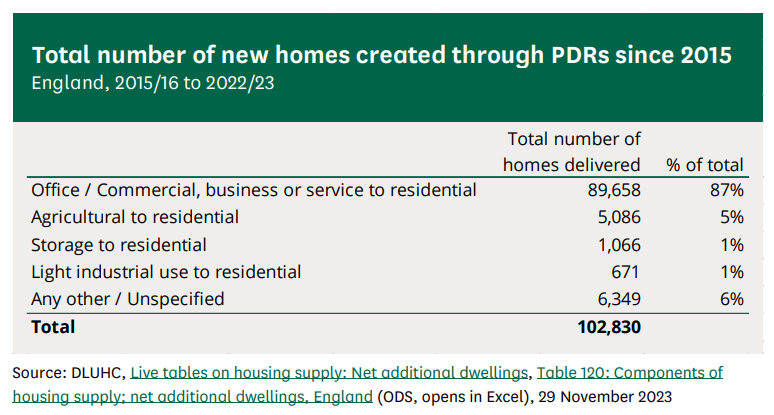
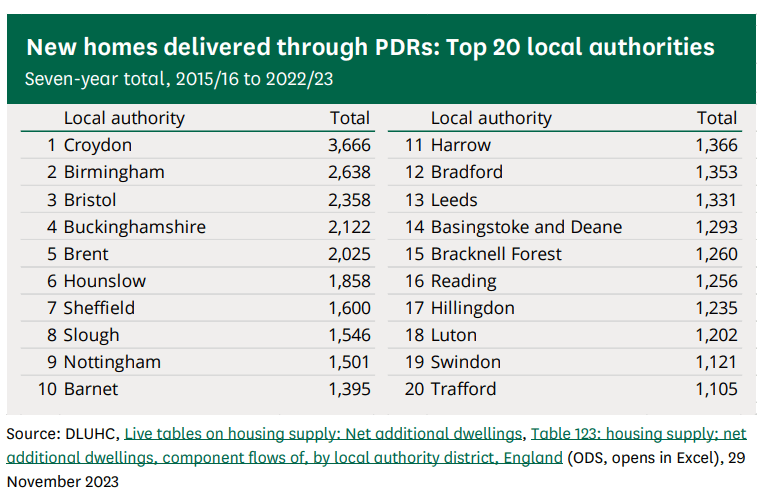
According to a House of Commons Library Briefing paper, between 2015/16 and 2022/23, 102,830 new homes were delivered through change-of-use Permitted Development Rights without planning permission. Most of these homes (89%) were created through conversion of offices, other commercial business and retail units. They comprised around 6% of the net additional homes delivered between 2015/16 and 2022/23.
Read on below or download a PDF here.
The consequences were often dire with some appalling properties produced, even some without windows. In 2020, a government-commissioned report found that PDR often resulted in poor-quality homes that failed to meet space standards. Shelter said units created through PDR schemes provided “substandard” accommodation for vulnerable families, which could have a “devastating impact” on their health and wellbeing. The Royal Town Planning Institute said there had been “a tendency for the very worst conversions, such as Terminus House in Harlow, to end up being occupied by large families in difficult circumstances.” The London School of Economics said the fact that “many PDR properties end up as temporary accommodation” reflected “their relatively low standards”. The LGA agreed. “Substandard and poorer quality homes developed through PDR are more likely to be used to house vulnerable people such as those in temporary accommodation.”
The Parliamentary Housing, Communities and Local Government Committee expressed concern that some homes delivered through PDRs were “of poor quality and situated in unsuitable places”. PDRs “tend to produce too many studio and one-bedroom flats and not enough family homes”. The LGA also raised concerns that Local Planning Authorities could not require developers to deliver affordable housing or supporting infrastructure for PDR schemes. It called for an end to conversions through PDR without planning permission.
David Renard, (Tory) LGA housing and planning spokesman, said:
“This independent report rightly backs our long-standing concerns over the detrimental impact on local communities of rules allowing home conversions without planning permission. It provides further evidence on why it is more vital than ever that planning should remain local.
Under these rules, communities have no way to ensure developers build high-quality affordable homes in the right places, provide any affordable homes as part of the development, along with infrastructure that provides enough schools, promotes greener and more active travel, and tackles climate change.
Developers must no longer be allowed to bypass the planning system and local communities must be able to have a say on all new developments in their area. It is vital that councils and local communities have a voice in the planning process and are able to oversee all local developments so councils can deliver resilient, prosperous places that meet the needs of their communities.”
“Poor quality/slum housing”
In February 2024 the Tory government introduced a consultation on extending PDR to include upwards building (extra floors on top) and demolition and rebuild. In response, then Shadow Housing Minister Matthew Pennycook said that
“Not only will a further expansion of permitted development rights do little if anything to boost supply, but it will add to the quantum of poor-quality/slum housing that post-2013 PDR expansion has created.” (Our emphasis)
Shaun Davies (elected as a Labour MP in July) for the LGA said in response to Gove’s proposals
“Further expanding permitted development rights risks creating poor-quality residential environments that negatively impact people’s health and well-being, as well as a lack of affordable housing or suitable infrastructure.”
The president of the Royal Institute of British Architects, Alan Jones, described the extensions of the policy as “disgraceful”, leading to more homes with rooms that will be “smaller than in budget hotels”. “There is no evidence that the planning system is to blame for the shortage of housing,” he says, “and plenty to suggest that leaving local communities powerless in the face of developers seeking short-term returns will lead to poor results.”
In October of this year the Chartered Institute of Housing said that
“The unintended consequence of these changes was the production of dire quality conversions you could barely call a home. In response to significant concerns about the slum-like conditions produced under PDR, the then government introduced minimum space standards and natural light requirements.
But they entirely ignored other concerns, such as the poor location of conversions without access to play space, schools and amenities; resident exposure to air pollution on active industrial sites and along major roads; poor building accessibility for young families, disabled and elderly residents; overcrowding; overheating; damp issues – the list goes on.
The rule changes also cut developer contributions towards affordable housing and undermined local planning policies that specifically aim to create healthy communities.”
Chartered Institute of Housing October 1st 2024
Dr Isobel Braithwaite, public health registrar and housing and health researcher at University College London, who worked with the medical charity/campaign Medact in Harrow, said:
“The experiences of the tenants we have worked with through Medact’s work in some permitted development blocks are shocking, and sadly theirs are not isolated experiences. The lack of basic scrutiny and protections to ensure that new homes created via PDR meet basic standards on issues such as lack of space, ventilation/condensation, natural light, overheating and fire risks raise very serious health concerns.
More affordable housing is urgently needed, but it is also essential that housing is healthy and safe, and the roll-out of PDR legislation has not fundamentally addressed the housing affordability crisis….the associated roll-back of standards and protections has left thousands of often vulnerable people living in unsafe and/or unhealthy conditions, many paying high rents for the privilege.”
Shameful…Dickensian
Given such widespread opposition to PDR as a producer of “poor-quality/slum housing”, including its own (pre-election) opposition, why would the new government decide not to end these rights, and only “keep them under review”? When the government admits that its target of 1.5 million homes will be hard to achieve, it’s difficult to draw any other conclusion than PDR is seen as helping to push towards a target that is viewed with scepticism including by its own councillors.
Hugh Ellis, policy director at the Town and Country Planning Association, said: “It is shameful that Labour has allowed this policy to continue. It is Dickensian – tolerating the creation of slum housing for those people most in need.” Ellis said not all the homes built via office-to-residential schemes were substandard, but the projects needed to be properly regulated under the planning process to ensure high-quality and affordable new homes. “This is a free-for-all,” he said.
The abandonment of opposition by the Labour government should be viewed with alarm by Labour Party members and supporters of council housing. Simply rushing to build numbers of new properties, whatever they are, will not resolve the housing crisis. It will make it worse. Housing should improve people’s lives not create new problems by allowing the amoral rush to amass profits by building shoddy, cramped flats, bad for their health and mental well-being. PDR has been used as a means of profiteering; creating a revenue stream with no concern for the quality of the ‘homes’ built.
The housing crisis cannot be resolved by the market, especially one in which deregulation allows numbers to trump quality. The government should be told in no uncertain terms that they should end conversions without planning permission. We don’t want to add to the stock of “poor quality/slum housing” do we?
There is no substitute for funding a renaissance of council house building/acquisitions on the scale of 100,000 a year. If it is seen as a political priority the funding can be found. An announcement of Labour’s replacement of the Tories Affordable Homes Programme is expected at the same time as the Spring Spending Review (put back to June). During the coming months pressure needs to be brought to bear on the government to provide the funding for councils to begin building council housing on a large scale. This is what is required rather than a mad dash for numbers regardless of quality or tenure.
Martin Wicks
December 29th 2024
 Labour Campaign for Council Housing
4 thoughts on “Do we really want more “poor quality/slum housing”?”