With thanks to Paul Watt, we reproduce here his submission to the All Party Parliamentary Group on Council and Social Housing inquiry on the barriers to building and acquiring social rent council housing. Paul is Emeritus Professor in Urban Studies at Birkbeck, University of London, and Visiting Professor in the Department of Sociology, London School of Economics and Political Science. p.watt1@lse.ac.uk
Summary: This response focuses on estate regeneration rather than new supply of social housing in general. Estate regeneration via demolition and rebuild is often lauded by local authority and housing association landlords as a quick-fix silver bullet which will help to ‘solve the housing crisis’ via providing more homes, including new social rental homes, at little public cost because the private sector will do the financial heavy-lifting, notably via the creation of public private-partnerships with private developers.
I have been conducting research on estate regeneration over many years and have published extensively on this topic including an internationally recognised monograph – Estate Regeneration and Its Discontents: Public Housing, Place and Inequality in London (Watt, 2021) – which is based upon in-depth research conducted at fourteen regeneration schemes in London. This response draws upon my research and other evidence to highlight why following the dominant narrative of ‘estate demolition will help to solve the housing crisis’ is a fundamentally flawed strategy not least from the standpoint of increasing the supply of social housing.
Read on below or download a PDF here
Social housing provision and losses
Council housing, as provided by local authorities [LAs], witnessed an eight decades-long ‘expansionary period’ from 1900 to house around one-third of the population by 1981 (Watt, 2021). In stark contrast, the following ‘contractionary period’ from 1980 onwards has involved a shrinking council housing sector resulting from a slump in new provision coupled with extensive sales, demolitions and stock transfers to housing associations [HAs] (ibid.). Although the HA sector has grown substantially from the 1980s, this has not made up for the reduction in council housing since the combined LA/HA stock in England contracted by around one quarter from its 1979 peak of 5,540,000 to 4,142,000 in 2023 (MHCLG, 2025a).
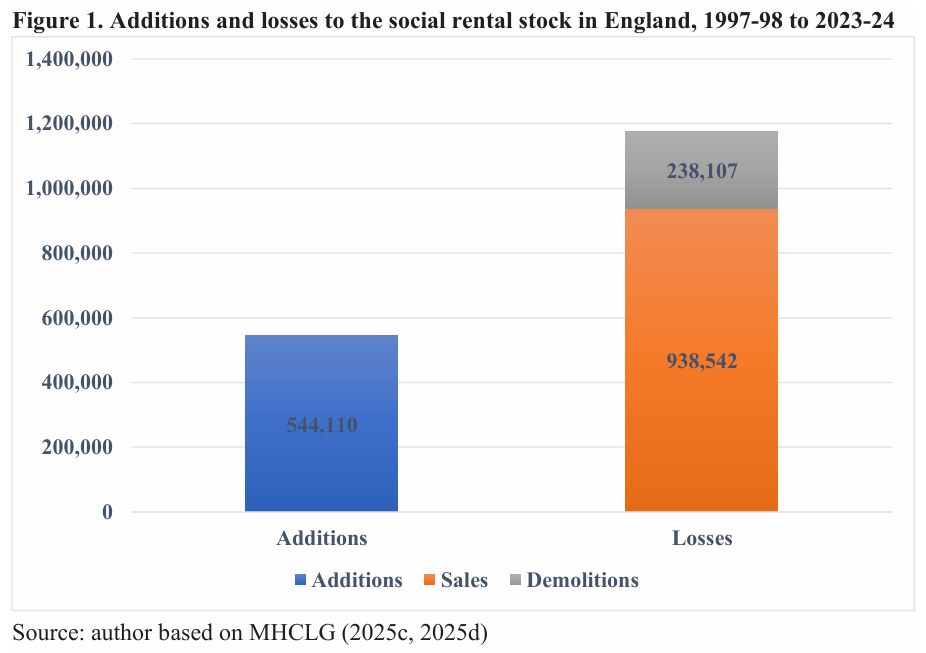
Shelter has been calling for 90,000 new social rental homes annually as the main way to solve the housing crisis or ‘housing emergency’ (Sagoe et al., 2020). However, a mere 10,153 social rent homes were completed in England during 2023-24 (MHCLG, 2025b). The situation is, however, even worse than this dire figure suggests since the existing social housing stock is being depleted due to a combination of sales (mainly via the Right-to-Buy [RTB] policy) and demolitions. Figure 1 shows the enormous scale of these losses from 1997-98 to 2023-24. Although 544,110 homes were added to the social rental stock over this period, 1,176,649 homes were lost due to sales (accounting for four-fifths) and demolitions (one fifth). In this response, I will focus on demolitions rather than sales, because the problems with the RTB are well rehearsed.
Demolition and estate regeneration
The demolition of council housing blocks can be traced back to safety concerns arising from the 1968 Ronan Point disaster. However, from the 1980s onwards, such demolition has not primarily been undertaken for safety reasons, but has instead occurred via estate regeneration (Kintrea, 2007; Watt, 2021). In addition to demolition and rebuild, estate regeneration can involve refurbishment of original buildings as well as community initiatives. The emphasis here, however, is on estate regeneration schemes involving either full or partial demolition of the existing social housing stock. Although some early estate regeneration schemes involved substantial public funding, since the 1990s they have been heavily reliant upon the ‘cross subsidy’ model of redevelopment for their realisation, i.e. building large numbers of market housing for sale in order to cross-subsidise any rebuilt social housing and/or building of other ‘affordable housing’ tenures such as shared ownership (Hodkinson, 2019; Watt, 2021; Penny, 2024).
Such regeneration schemes have reduced social rental housing in London and have hence worsened rather than improved the city’s housing crisis. In the absence of substantial public funding, the financial pressures arising from the cross-subsidy redevelopment model mean that there is typically less social housing at the very end of the scheme compared to its start. An LAHC (2015) report compared original and proposed homes at 50 demolished council-built estates in London and showed that social renting declined by 27% whilst market homes increased over ten-fold. In Watt (2021: 453-454), I examined 35 London regenerated HA estates and found a 25% reduction in social rental homes, whilst Penny (2024) has also identified a similar net reduction across six estate regeneration programmes in London. The social rental loss is even greater at certain high-profile regeneration schemes, for example 90% at the Heygate estate in Southwark (Watt, 2021).
In addition to such negative final outcomes, the regeneration process itself leads to fewer social tenancies due to two factors which arise over the often long duration of a typical demolition and-rebuild scheme. First, the prospect of demolition spurs increased RTB applications which arise from a combination of sitting council tenants seeking to financially gain from the compensation payments available to RTB homeowners, alongside the interventions of private companies who ‘partner’ with said sitting tenants (Watt, 2021). Hence the numbers of RTB owners increases at estates scheduled for demolition whilst the amount of council tenancies concomitantly declines. Second, the lengthy demolition process results in the proliferation of empty homes due to the decanting of tenants and buying out of homeowners, and hence LAs and HAs have less stock available for social rent. For example, regeneration began at the Carpenters council estate (with over 700 properties) in Newham in 2004. The council subsequently decanted most of the original tenants such that by 2018 there were nearly 400 empty properties at the estate even though no redevelopment had occurred (Watt, 2021). A similar situation happened at another Newham regeneration scheme in Custom House (Watt, 2021; Brennan, 2025), i.e. in a borough with the highest number of homeless households in the country.
One of the main aims of my research has been to understand how residents experience living through the protracted regeneration process. I have identified a series of largely unforeseen discontents which centre around what I refer to as ‘degeneration’: “regeneration’s demonic alter ego in the form of financial disinvestment in those areas and their accelerated physical, social and symbolic deterioration over and above any original problems they might have” (Watt, 2021: 253). Estates undergoing ostensible ‘regeneration’ degenerate in multiple ways including: managed decline via worsening repair and maintenance services; erasure of neighbourhood facilities; noise and dust arising from living on a building site; and the growth in empty and unsightly boarded-up properties.
One often overlooked factor is how the regeneration process elongates way beyond its predicted completion date. Such elongation partly resulted from delays arising from the 2008 financial crash, but also from the convoluted organisational and fiscal intricacies and tensions surrounding public-private-partnerships and Local Housing Companies, plus the reluctance of private developers to build at pace for fear of ‘flooding the market’ with unsellable properties (Hodkinson, 2019; Colenutt, 2020; Watt, 2021; Lord Kerslake, 2022; Penny, 2024). Several regeneration schemes that I examined will take over 20 years to completion with some stretching out over 30 years. Regeneration at the Aylesbury, Clapham Park and South Kilburn estates was initiated via the New Deal for Communities [NDC] programme which began in the late 1990s and was due to conclude by 2010. In each of these London NDC cases, the decision was subsequently taken to demolish and rebuild most of the original estate, but the end date has been extended to an estimated astonishing 2035. Residents at these estates have to endure degeneration effects such as sub-standard repairs and maintenance for far too many years (Watt, 2020, 2021, 2023; Firmin, 2025).
In fact, there are many examples of regeneration schemes which have extended well beyond their planned original time-scale and which manifestly exemplify the degeneration features that I have emphasised, including Grahame Park (Social Life, 2024) and Thamesmead in London (Wainwright, 2022). Indeed the contemporary social housing landscape in England is littered with half-started, stalled, never-ending demolition-and-rebuild schemes which have been running for a decade or more (Wallace, 2015; Lord Kerslake, 2022; Brennan, 2025; Firmin, 2025; Khaliq and Hawksworth, 2025; Lewis, 2025; Clarke, 2026; Owen, 2026).
Conclusions
In conclusion, demolition-and-rebuild schemes result in multiple resident discontents and degeneration effects and should be the very last regeneration option. Rather than ‘solving’ the housing crisis, such schemes exacerbate it in the short-medium term since they result in both increased RTB sales and empty LA/HA properties, and also in fewer social rental homes at their eventual end-point which could well be decades into the future. As Figure 1 highlights, the demolition of existing social housing forms part of the national housing problem rather than its solution. Other regeneration strategies, such as refurbishment/retrofitting, have the potential to realistically improve estates and residents’ lives over much shorter time-scales and with far less degeneration and negative environmental effects than demolition and rebuild (Crawford et al., 2014; Belotti, 2016; AAB Architects, 2026).
References AAB Architects (2026) Resident-led improvement and retrofit for housing estates. London: AAB Architects. https://www.aabarchitects.co.uk/resident-led-retrofit-toolkit-for-housing-estates/
Belotti, A. (2016) Estate Regeneration and Community Impacts (CASE Report 99). London: LSE Housing and Communities, London School of Economics.
Brennan, J. (2025) Custom House, Our House: A community archive of regeneration, power and collective voices. London: Silent Grid.
Clarke, I. (2026) ‘Review of the Year 2025: The cost of the Aylesbury Estate regeneration was revealed’, Southwark News, 4 January. https://southwarknews.co.uk/area/walworth/review-of-the-year-2025-the cost-of-the-aylesbury-estate-regeneration-was-revealed/
Colenutt, B. (2020) The Property Lobby: The Hidden Reality Behind the Housing Crisis. Bristol: Policy Press.
Crawford, K., Johnson, C., Davies, F., Joo, S. and Bell, S. (2014) Demolition or Refurbishment of Social Housing? A Review of the Evidence. London: UCL Urban Lab and Engineering Exchange. Firmin, P. (2025) ‘Some home truths about the South Kilburn regeneration for Brent Council and developers to ponder’, Wembley Matters, 21 May 2025. https://wembleymatters.blogspot.com/2025/05/some-home-truths-about-south-kilburn.html Hodkinson, S. (2019) Safe as Houses: Private Greed, Political Negligence and Housing Policy After Grenfell. Manchester: Manchester University Press.
Khaliq, Z. and Hawksworth, V. (2025) ‘Inside the eerie South London estate that was left abandoned for almost 10 years’, MyLondon, 11 February. https://www.mylondon.news/news/south-london-news/inside-eerie-south-london-estate-30983611
Kintrea, K. (2007) ‘Policies and programmes for disadvantaged neighbourhoods: recent English experience’, Housing Studies, 22(2): 261-282.
LAHC [London Assembly Housing Committee] (2015) Knock It Down or Do It Up? The Challenge of Estate Regeneration. London: GLA.
Lewis, J. (2025) ‘Townhill Park regeneration delay – “couldn’t make it up”’, Southern Daily Echo, 22 July. https://www.dailyecho.co.uk/news/25329276.townhill-park-regeneration delay-couldnt-make-up/
Lord Kerslake (2022) Kerslake Review of Affordable Housing in Lambeth. London: Lambeth Council.
MHCLG [Ministry of Housing, Communities & Local Government] (2025a) Live Table 104: Dwelling stock by tenure, England (historical series). https://www.gov.uk/government/statistical-data-sets/live-tables-on-dwelling-stock-including-vacants
MHCLG (2025b) Live Table 1000: Additional affordable homes provided by tenure and provider, England. https://www.gov.uk/government/statistical-data-sets/live-tables-on-affordable-housing-supply
MHCLG (2025c) Live Table 684: Demolitions of social housing stock, England, 1997-98 to 2023-24. https://www.gov.uk/government/statistical-data-sets/live-tables-on-social-housing-sales MHCLG (2025d) Table 678: Social housing sales: Annual sales by scheme for England, 1980 81 to 2023-24. https://www.gov.uk/government/statistical-data-sets/live-tables-on-social-housing-sales Owen, M. (2026) ‘There are dozens of empty homes but families like mine are living in limbo’, BBC News, 10 February. https://www.bbc.co.uk/news/articles/cvgdzr8kj06o
Penny, J. (2024) The Promise of Cross-subsidy: Why Estate Demolition Cannot Solve London’s Housing Emergency. London: Public Interest Law Centre.
Sagoe, C., Weekes, T. and Stratton, E. (2020) A Capital in Crisis. London: Shelter. Social Life (2024) Living in Grahame Park. London: Social Life.
Wainwright, O. (2022) ‘What happened to the cockney riviera? The botched regeneration of brutalist utopia Thamesmead’, The Guardian, 30 November. https://www.theguardian.com/uk-news/2022/nov/30/cockney-riviera-botched-regeneration brutalist-utopia-thamesmead.
Wallace, A. (2015) ‘Gentrification interrupted in Salford, UK: from New Deal to limbo-land in a contemporary urban periphery’, Antipode, 47(2), pp. 517-538.
Watt, P. (2020) ‘Territorial stigmatisation and poor housing at a London “sink estate”’, Social Inclusion, 8(1): 20-33. https://www.cogitatiopress.com/socialinclusion/article/view/2395
Watt, P. (2021) Estate Regeneration and Its Discontents: Public Housing, Place and Inequality in London. Bristol: Policy Press.
Watt, P. (2023) ‘Taking a long view perspective on estate regeneration: Before, during and after the New Deal for Communities in London’, Journal of Housing and the Built Environment

