The ‘new-builds’ website has produced a very useful ‘Housing output Report 2026‘. It draws on company results, NHBC (the leading provider of warranty and insurance for new homes) registration data, and industry analysis from the House Builders Federation. The top 10 house builders, by numbers built, produced approximately 81,600 homes in 2024/25, representing 55% of English completions. The report says that this highlights the sector’s “extreme concentration”. The remaining 45% come from mid-tier regional builders (firms delivering 500-3,000 home a year) and SME builders (under 500 a year), housing associations and self/custom builders.
The degree of concentration of the sector is highlighted by the fact that two of the ten – Redrow Barrett and Vistry – constructed 41.9% of all completions.
Read on below or download a PDF here
The absence of competition is reflected by the specialisation of these companies. For instance
- Berkeley Group average price of £610,00 reflects its concentration on high value London and South East regeneration schemes.
- Keepmoat’s £213,000 average reflects its focus on affordable partnership-led housing in the Midlands and North East.
The Competition & Markets Authority launched its probe into “suspected anti-competitive conduct by housebuilders” in February 2024. Between January 2022 and February 2024 seven companies exchanged details about sales including pricing, number of property viewings and incentives offered to buyers, such as upgraded kitchens or stamp duty contributions. Rather than making a decision on whether they had infringed the Competition Act 1998, they came to a settlement with the seven companies. Instead it dropped its investigation in return for a collective payment of £100 million towards “affo0rdable homes” and some other commitments in relation to information sharing. If there had been no breach of the Act, why would they demand £100 million?
Margin
The large volume house builders have been pleading poverty of late in the face of increasing costs. However, the report estimates the sector margin for the financial year 2025 to be 21.4%. This is down from the “pre-pandemic norm of 24.6%”. With the exception of the wilder reaches of the financial sector other sectors wouldn’t complain about their margin being 21.4%. This is double or more of the margins of the top five (non housing) construction companies in 2024.
For many years now the focus of these shrinking numbers of large volume builders has been margin over volume. In particular, profit per unit is what drives them. The UK Collaborative Centre for Housing Evidence did a report in 2023 which highlighted how the ‘big three’ (Taylor Wimpey, Barratt and Persimmon) adopted a margins over volume strategy, “allowing them to generate large amounts of cash, most of which has been returned to the shareholders”.
Land banking
For all the talk of planning delays slowing down building, the top five house builders have 281,000 plots with planning permission. That varies between 4.2 and 11.3 years of supply lined up. In addition they have control of 226,000 ‘strategic land’ plots, typically through “option or conditional purchase agreements”, representing a ‘pipeline of future development’.
Diversification into Partnership and BTR
Vistry group has led the industry towards partnership and affordable housing delivery. Other builders are following. Barrett Redrow has expanded its partnership housing division. Persimmon has established a new partnership team targeting housing association bulk sales. The growth of the build to rent (BTR) sector is creating “an additional channel for forward-sold volume (agreement to buy at an agreed price before building begins)”.
Whatever happened to SMEs?
In 1988 the share of house building by small builders (less than 100 homes per year) was 39%. In 2025 it had collapsed to 12%.The reasons include difficulty accessing finance and the dominance of large builders in land markets, buying up land and taking out options for future use. This is what happens when a market is dominated by an oligopoly.
In 1980, there were over 10,000 small and medium enterprise (SME) housebuilders active in Great Britain, building 57% of all new housing; by 2014, this had dropped to 3,000 SME builders delivering just 27% of all new dwellings.
The government has taken some measures aimed at supporting SMEs, including
- The Levelling-up Home Building Fund (a £1.5 billion lending programme), small site planning reforms, allowing more sites under 50 units to be approved by delegated powers (i.e. council officers determining planning applications) and
- The proposed Infrastructure Levy Exemption for sites under 10 units.
Early sites are “cautiously positive”. The Federation of Master Builders has reported a 6% increase in SME starts.
August 14th 2026
Addendum
Although it is 10 years old this research by Archer and Cole is well worth reading. It shows the process of concentration in the house building sector and what might be described as superprofits driven by Help to Buy.
“From 2012-15, the output of the nine largest private housebuilders grew by 33 per cent. Revenues increased by 76 per cent. In the same time frame, profit before tax (prior to the removal of exceptional items and financing costs) rose by nearly 200 per cent for these nine firms. Over a slightly longer period, 2010-15, the profits before tax of the top five housebuilders increased by 473 per cent. End of year profits for the biggest five firms (after taxation, impairments and exceptional items are taken into account) increased from £372 million in 2010 to over £2 billion by 2015 – an increase of over 480 per cent.”
The table below, from research in 2021, shows a near doubling of profits per unit, from 2005 to 2017, despite the Great Financial Crash which saw a collasse to £6,358 per unit in 2009..

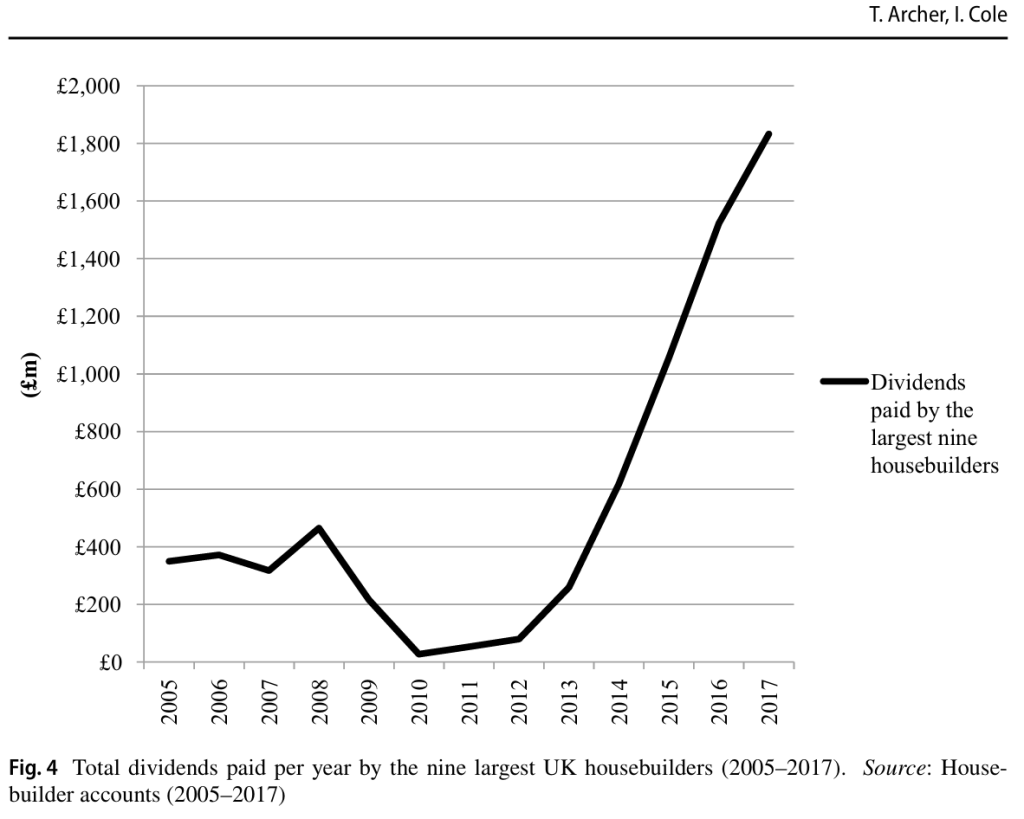
And this huge increase in dividends.


One thought on ““Extreme concentration” of house building”