Dear John
Congratulations on being appointed chancellor. You are now in a position where you can facilitate the improvement of existing homes, and the delivery of a new generation of council homes, that are so desperately needed to help resolve the housing crisis.
I have taken the opportunity on behalf of the Labour Campaign for Council Housing to summarise why we and other organisations are calling on the Labour government to cancel the Housing Revenue Account (HRA) debt and so release councils up and down the country from this additional burden which they can ill afford.
Read on below or download a PDF here
You may be aware that Shelter is calling for the government to cancel HRAt debt. They highlight the outdated “debt settlement” of 2012 which has been undermined by subsequent policies. This is an issue you will remember from 2019 when you were Shadow Secretary of State for Housing. During the Manifesto process the trade union section of it asked for a commitment that a Labour government would cancel the debt. You agreed to review the debt and this was incorporated into the General Election Manifesto. Unfortunately, the loss of the election meant that we didn’t get the opportunity to implement a review. Since then, the idea has been forgotten or dropped.
As Chancellor, you are now in a prime position to be able to address this question. It is an urgent matter because there is a question mark over the future of existing council housing, which is not only underfunded, for reasons we explain below, but because the government is asking councils to take on extra tasks related to new Standards and laws, such as Awaab’s Law, fire and safety rules, an updated Decent Homes Standard, and decarbonisation of council housing. We support these, but without additional funding councils will struggle to implement them. The 109 councils that signed the document “Securing the future of council housing”, issued a warning that
““England’s council housing system is broken and its future is in danger. An unsustainable financial model and erratic national policy changes have squeezed budgets and sent costs soaring.
Unless something is done soon, most council landlords will struggle to:
- maintain their existing homes
- meet the new demands to improve them
- build new homes for social rent
Across the country development projects are being cancelled and delayed. This affects the local construction sector, jobs and housing market.
The reality is that some councils will have no option but to sell more of their existing stock to finance investment in an ever-shrinking portfolio of council homes.”
The Chartered Institute of Housing has also added its warning.
“In 2012, the government and local authorities agreed a self-financing settlement, aimed at making Housing Revenue Accounts sustainable and allowing for growth and investment. But the assumptions made then no longer fit with the financial and policy environment as it has evolved since 2012. The impact of rent controls, sustained higher-than-expected inflation, loss of stock through right to buy, and new regulatory burdens have all undermined the original settlement. The result is that councils have unsustainable debt levels and there is simply not enough money in the system to allow council housing to be run properly.” (Our emphasis)
Causes of underfunding
Historic and current policies have caused the chronic under-funding of HRAs. In reality most of the so-called debt has been the result of financial manipulation by the Treasury. From 1979 to 1997, council tenants’ rent was effectively stolen by various means. For instance, HRAs couldn’t keep their annual surpluses. They were handed over to council General Funds. Instead of being spent on the upkeep of council homes they were used for non-housing purposes That’s why there was a £19 billion backlog of work when Labour came into office in 1997. Whilst Labour’s Major Repairs Allowance enabled the modernisation of council homes, with central heating, double glazing and UPVC doors, the phenomenon of ‘negative subsidy’ grew under the Blair government.
In its review of the Council Housing Subsidy System (CHSS) in 2005, the Audit Commission found that 83% of councils suffered from ‘negative subsidy’. In other words, instead of receiving subsidy they were paying into the central system, effectively subsidising the Treasury. The Audit Commission predicted that if the CHSS remained in place, then eventually, all council HRAs would go into ‘negative subsidy’. The system was unsustainable. That was why a new financial system, ‘self-financing’, was devised.
Under the CHSS, in the 25 years to 2008, councils had ‘annual allowances’ of £60 billion, yet council tenants paid £91 billion in rent. The £31 billion difference was more than historic debt associated with previous building programmes. That was why Defend Council Housing, trades unions and others, called for the so-called debt to be written off. Council tenants had been thoroughly fleeced.
Although self-financing ended ‘negative subsidy’, HRAs were underfunded from the start. The Labour government had admitted (in response to a Parliamentary question) that councils would need an increase in resources of 67% to facilitate all the work required on their housing. Yet, when self-financing was introduced the increase in the Management & Maintenance Allowance was 5% and the Major Repairs Allowance 28%.
In the 2012 ‘debt settlement’ 136 councils were loaded up with an extra £13 billion debt. The debt that each council was given was based on assessments of income and expenditure over 30 years of the business plans they were obliged to draw up. The amount of debt each council was given was based on calculations which would prove to be grossly inaccurate. Government policies further undermined the financial basis of the settlement because HRA income was far less than assumed.
No sooner was the new system introduced than its finances were undermined. For example
1) When a council house is sold under Right to Buy the council does not only lose the property, it loses the rental stream. The ‘enhanced’ Right to Buy, which the coalition introduced, increased the discount for tenants. This increased sales fourfold. The amount of ‘debt’ each council was given was, in part, based on a projection of a much lower number of sales. Hence, the loss of rental income was far higher than included in the settlement.
2) The four year rent cut introduced by the Tories in 2016 had a huge impact. The Chartered Institute of Housing estimated a direct loss over the four years, of £2.6 billion, and a cumulative loss of £42 billion over 30 years.
The recent Savills report for Shelter points out that “debt was relatively stable at between £26-£27 billion from 2012 to 2022” but has risen to £31.8 billion. Evidence suggests that new debt being taken out is largely to fund capital works on existing homes, to bring them up to the new standards. The report says “There is likely to be a continued need to borrow for investment into the existing stock.” That itself is a reflection of the underfunding of HRAs.
The message from a wide range of organisations, from Shelter, the Chartered Institute of Housing, the Local Government Associations and campaigns, is clear. The debt is unsustainable. The government is asking councils to do much more without the resources to fund the necessary work.
Whilst debt cancellation in itself will not resolve this financial crisis, it should be done to rectify the historic injustice that tenants have suffered. What will it cost the government to cancel the debt? Approximately £1.2 billion a year; the cost of servicing it, which goes to the Public Works Loans Board. As the Chartered Institute of Housing has said, the extra funding is likely to be directed to capital investment or major repairs, which would generate additional income for central government via income tax, VAT, etc. In any case, if the government wants to promote a renaissance of council housing we can’t allow existing council housing to deteriorate, with a worsening of living conditions for tenants. You cannot demand councils improve the standard of their housing if they are denied the resources to do it.
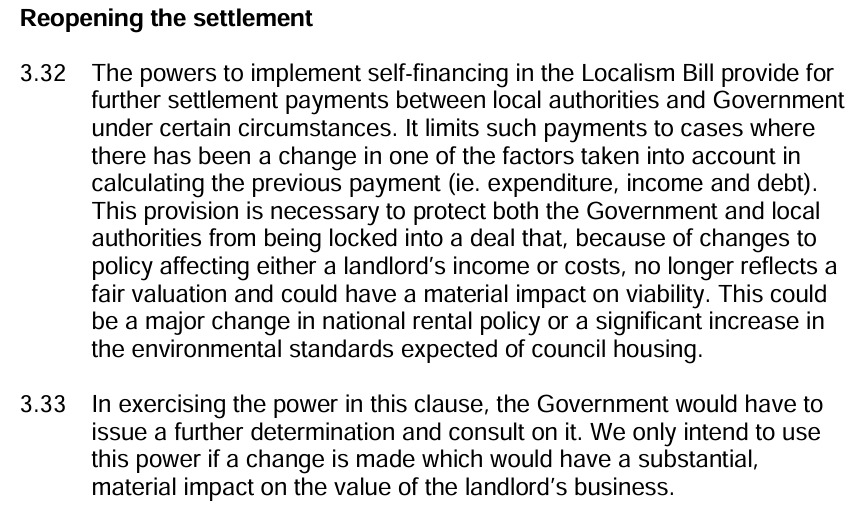
The 2011 Localities Act gives the government power to amend or revoke the debt-settlement payments which were made in 2012. Implementing Self-financing for council housing (see Note below)indicates that further settlement payments will be limited to “one of the factors taken into account when calculating the previous payment (i.e.income, expenditure or debt)”. Further, it goes on to say that “This provision is to protect both the government and local authorities being locked into a deal that, because of changes to policy affecting either a landlord’s income or costs, no longer reflects a fair valuation, and could have a material impact on viability.”
Maintaining the 2012 debt settlement is precisely such a ‘deal’. Implementing Self-financing for council housing even cites “a major change in rental policy” (a 4 year rent cut?) or “a significant increase in environmental standards expected of council housing” (decarbonisation?) as reasons for reopening the settlement! Policy changes since then have certainly had “a material impact on the value of the landlord’s business”. Since councils, collectively, are losing (over the 30 years of their business plans) tens of billions of pounds as a result of the four year rent cut alone, and government policies have imposed further duties on them, there is an indisputable case for reopening the 2012 debt settlement.
Finally, we believe that we have shown, in brief here, but in more detail elsewhere, that the debt should be cancelled, giving an immediate boost to the finances of Housing Revenue Accounts of more than £1 billion a year. It is desperately needed to maintain and improve the quality of existing homes.
We would be keen to meet up with you and/or your team at the earliest opportunity to discuss the pressing need to cancel the debt.
I look forward to hearing from you.
Martin Wicks
on behalf of the Labour Campaign for Council Housing
Note
Implementing Self-financing for council housing, February 2011, Department for Communities & Local Government

